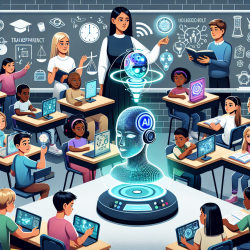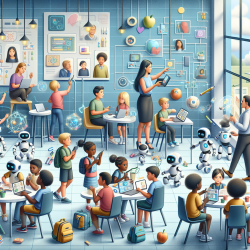
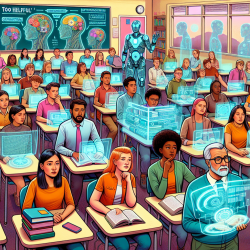
AI is now a daily reality in many classrooms. In Australia, the adoption curve has been steep: nearly 80% of students report using AI, and early secondary teachers are among the highest users in the OECD. With that kind of momentum, the real question is no longer “Will students use AI?” but “How do we make sure AI use strengthens learning instead of replacing it?”
A March 2026 report from the Network for Quality Digital Education, authored by Prof Jason M. Lodge and Prof Leslie Loble AM, offers a helpful lens for answering that question: cognitive offloading. In simple terms, cognitive offloading is when we shift mental work to an external tool. That can be as harmless as writing a to-do list—or as consequential as asking a chatbot to do the thinking that school is designed to develop.
For schools, this matters because the risk isn’t only cheating or shortcutting an assignment. The deeper risk is that unstructured AI use can interfere with the cognitive processes that build durable knowledge, critical thinking, and self-regulated learning.
First, a quick refresher: how learning “sticks”
The report draws on Cognitive Load Theory, which explains learning through two key memory systems:
- Working memory: the “mental workspace” where we process new information. It’s limited and can overload easily.
- Long-term memory: where knowledge is stored in structured “schemas.” This is where expertise lives.
Learning happens when students use working memory to process information and gradually build schemas in long-term memory. That schema-building requires effort. And that effort is not a bug in learning—it’s the point.
Cognitive offloading: helpful support or harmful outsourcing?
AI makes cognitive offloading incredibly easy, including offloading complex tasks like summarising, analysing, synthesising, and drafting. The report’s central distinction is this:
- Beneficial cognitive offloading: using AI to reduce extraneous load (unnecessary effort) so students can focus on the core learning.
- Detrimental cognitive offloading (outsourcing): using AI to bypass intrinsic load (the essential thinking required to learn).
In practice, that difference can look like this:
- Beneficial: “Check my grammar,” “Help me brainstorm counterarguments,” or “Generate practice problems so I can practise.”
- Detrimental: “Write my essay,” “Give me the answer,” or “Solve this and explain it so I don’t have to.”
One approach supports learning; the other replaces it.
The “performance paradox”: why AI can look like it’s working while learning gets worse
One of the report’s most important insights is the performance paradox: students can appear to perform better with AI in the moment, but their long-term learning can suffer once the tool is removed.
Research cited in the report includes a large study in high school mathematics (nearly 1,000 students) showing that AI support improved problem-solving during practice, but students learned less when tested without AI. In other words, AI helped them do the work, but not necessarily learn the work.
This is why educators can feel whiplash. A student’s output might improve immediately—more fluent writing, faster completion, cleaner formatting—while the underlying knowledge and independence quietly erode.
Why it happens: “desirable difficulties” and the illusion of competence
Durable learning often requires what cognitive scientists call desirable difficulties: productive struggle like retrieval practice, generating an answer, revising a draft, or working through confusion. These are the moments when schemas are built.
When AI becomes an “answer oracle,” students can bypass those desirable difficulties. The report connects this to two common patterns:
- Illusion of competence: AI output is fluent and confident, which can trick students into thinking they understand more than they do.
- Metacognitive laziness: students offload not just the task, but the self-regulation around the task (planning, monitoring, revising).
This is especially risky for novice learners—students who are still building foundational knowledge and don’t yet have the domain expertise to spot subtle errors, bias, or weak reasoning in AI-generated content.
The equity issue: a new “metacognitive equity gap”
The report raises a critical equity concern: unstructured AI use may widen gaps between students who already have strong knowledge and self-regulation, and those who don’t.
Students with stronger domain knowledge and metacognitive skills are more likely to use AI as a tool for beneficial offloading (for example, using it to refine writing while still doing the thinking). Students who lack those foundations are more vulnerable to outsourcing—accepting AI output passively, building dependence, and missing the learning they need most.
That creates a modern version of the “Matthew Effect”: the students who are already ahead may accelerate, while students who are behind may fall further behind—simply because AI is easier to use poorly than well.
So what should schools do? Move from atrophy to augmentation
The report is clear: outcomes are not technologically predetermined. They are pedagogical. The same AI tool can support deep learning or undermine it depending on how it’s structured, scaffolded, and taught.
Here are practical, evidence-aligned directions schools can take.
1) Teach “what to offload” (and what not to)
Students benefit when educators explicitly define acceptable, learning-supportive uses of AI. A helpful rule of thumb is:
- Offload polish (grammar, clarity, formatting, idea expansion).
- Keep the thinking (claims, evidence selection, reasoning, problem-solving steps, reflection).
This aligns with research showing that when students are taught to delegate lower-order tasks to AI while retaining higher-order analysis, critical thinking can improve.
2) Build metacognitive “speed bumps” into AI use
Because AI fluency encourages overconfidence, students need structured pauses that force reflection. Schools can embed prompts like:
- “What do I already know about this topic?”
- “What is my claim, and what evidence supports it?”
- “Which parts of this AI output might be wrong or incomplete?”
- “What would I change, and why?”
Research cited in the report suggests that integrated metacognitive prompts can improve self-regulated learning and deepen inquiry—especially when they are non-optional and designed into the learning process.
3) Reframe AI as a verification partner, not an answer machine
One of the most powerful shifts is cultural: students should be taught that their job is to verify, not just to receive. In a verification mindset, students remain responsible for accuracy, logic, and quality.
This is where domain knowledge becomes even more important. The better a student understands the content, the better they can evaluate AI output.
4) Consider teacher-facing AI to scale expertise (not student dependence)
The report highlights a promising equity-forward direction: use AI to augment teachers. Instead of putting the highest-risk tool in the hands of the novice learner, schools can use AI to support educators with planning, differentiation, resource creation, and feedback workflows—while keeping the teacher as the primary learning designer.
Studies cited in the report suggest that AI can help scale effective instructional support and even provide real-time coaching to tutors, improving outcomes particularly where educator experience varies. For school systems facing staffing shortages and complex student needs, this “augment the teacher” model may offer benefits without encouraging widespread cognitive outsourcing.
What this means for TinyEYE and school-based support
At TinyEYE, we work with schools to expand access to therapy services through secure, online delivery. As AI becomes more present in classrooms, student support services and learning teams will increasingly be asked to help answer questions like:
- Which students are becoming over-dependent on tools?
- How do we strengthen self-regulation and reflection skills?
- How do we protect equity for students who need more scaffolding?
- How do we keep human relationships central while using digital tools wisely?
The core takeaway from the report is encouraging: the solution isn’t to ban AI or surrender to it. The solution is to structure its use so that students keep doing the cognitive work that builds lifelong learning capacity—while educators and support teams use technology to amplify high-quality instruction and care.
For more information, please follow this link.